The SaaS starter kit built for the agent era

Engineered so you and your AI agents build the part that makes money, not the boilerplate under it.

Get lifetime accessSee the demo

  • Bun
  • Hono
  • React 19
  • TypeScript
  • Postgres
  • Better Auth
  • Resend
  • Claude
  • Cursor

guardrails your AI agents followso their code fits the repository boundaries

the app your customers log intoit runs the minute you clone it

sign-up, teams, payments, emailworking on day one, not stubbed

your productthe only part left to build

one repo with the boring parts already finishedso you start on what makes your product different

What actually goes wrong.

Agents don't break your codebase in one commit.

They break it gradually: reading context nobody maintained, inventing a route through the code, and passing every check on the way to a regression you find two weeks later.

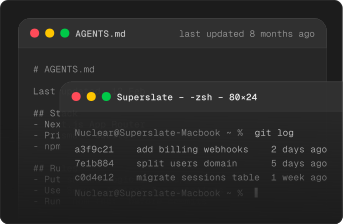
  • An AGENTS.md file last updated eight months ago, behind a terminal showing recent commits that changed the code since
    Someone wrote the context file months ago. Your agent is still working from it.
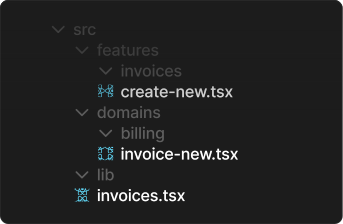
  • The same invoices feature created three times in three different directories: features, domains, and lib
    There's no established route for how features get built, so every agent takes a different one.
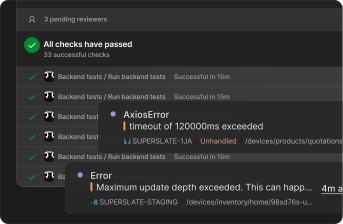
  • A pull request reporting 33 successful checks, overlaid by two production error reports
    The run comes back green and the PR looks right, but a regression shows up two weeks later.

Not an AI sticker on an old template.

Your codebase is half the harness.

You tuned the model, the prompts, the tools, and then dropped the agent into a repo it can't verify. Superslate is the other half: a map to read, boundaries to respect, and checks that prove every change.

AGENTS.md · the root contract, verbatim

Preserve its current architecture unless reproducible evidence requires a change. Optimize for a buyer reaching a deployed, paid, maintainable product, not for framework novelty or feature count.

Prefer the smallest reversible change that fixes the evidenced problem.

Scoped per directory. Your agent reads the closest one before it edits.

docs/golden-paths/ · maintained change recipes

  • add-domain-end-to-end.md
  • add-billing-gated-feature.md
  • add-authenticated-route.md
  • add-transactional-email.md
  • add-database-migration.md
  • diagnose-failed-webhook.md
  • deploy-fresh-application.md
  • remove-optional-subsystem.md

Maintained routes through common changes and failures, not hidden rules.

packages/agent-eval/ · measure it, don't vibe it

Run an agent against a task, then score the diff for boundary violations before it reaches review.

Plus agent-navigation-contract.json: which rules apply to which change, deterministically.

packages/agent-context/ · local and read-only

Six tools search version-matched docs and implementation, match navigation rules, load applicable invariants, and return the complete verification matrix without modifying source.

Optional STDIO context for Codex, Claude Code, and Cursor.

What you're not building.

Skip to the part that's yours.

Auth, billing, teams, uploads, email: the infrastructure every SaaS repeats is already here, wired end to end and tested against real Postgres. Your first commit is a feature, not a login form.

authentication

  • Password and magic-link sign-in
  • Optional Google provider
  • Email verification required
  • Reset revokes every session

Better Auth

billing

  • One contract, three providers
  • Signature-verified webhooks
  • Replays change nothing

Polar · Stripe · Dodo

organizations

  • Personal and team orgs
  • Invites, roles, transfers
  • Queries scoped by organization_id

personal + team

api contracts

  • One schema, three consumers
  • Types inferred, not duplicated
  • Drift is a compile error

Zod

database

  • Raw SQL in repositories
  • Migrations up and down
  • CI proves every rollback

Postgres + dbmate

email

  • Ten typed React templates
  • Local preview server
  • No key? Links go to the log

React Email + Resend

uploads

  • Presigned direct uploads
  • Staging bucket, then promote
  • Checked by bytes, not extension

R2 · S3 · GCS

ui kit

  • Tables, palette, pickers, toasts
  • Zag.js keyboard and ARIA
  • CSS Modules and tokens

45 components

notifications

  • One typed notification enum
  • In-app inbox and email
  • Per-type user preferences

inbox + email

i18n

  • English, Spanish, German
  • TypeScript locale files
  • Missing key fails the build

i18next · en · es · de

search

  • Postgres full-text search
  • Trigram indexes, typos match
  • No search service to run

Postgres FTS

error monitoring

  • First-party Sentry tunnel
  • Ad blockers cannot see it
  • Structured server logs

Sentry + pino

pwa

  • Installable, works offline
  • Real update prompt
  • Manifest and icons generated

vite-plugin-pwa

tests

  • Vitest in every workspace
  • 15 integration files
  • Real Postgres, not mocks

Vitest · 97 files

security

  • Secure headers and CORS allowlist
  • Body limits and timeouts
  • On every route

on by default

rate limiting

  • Per-route auth and app rules
  • Stored in Postgres
  • Nothing extra to deploy

Postgres-backed

docs

  • A shipped documentation app
  • Golden-path guides
  • llms.txt routes for agents

Fumadocs + llms.txt

Why this stack.

Opinionated, on purpose.

The modern TypeScript stack for a SaaS, chosen once and wired end to end: fast to run, strict to type, and familiar to every coding model. Every option you don't have is a decision that can't be made wrong.

frontend

React 19 SPAover server-rendered ambiguity

Code runs in the browser, never "it depends", and React is the framework every coding model has read the most of.

contracts

TypeScript + Zodover types by convention

One schema package carries full type safety end to end: the API validates it, the SPA infers it. Change a field and every consumer fails at compile time.

api

Honoover framework magic

Web-standard request handling: every route is a typed function you can read top to bottom.

runtime

Bunover a five-tool Node pipeline

One runtime for the API, scripts, tests, and the production binary. The whole test loop runs in milliseconds.

database

Postgres + dbmateover an ORM DSL

Plain SQL you can read in full. Nothing translates between you and your data, so nothing hides.

One decision, one maintained path.

Choose your cloud during setup.

Say yes in the CLI, choose a backend and static frontend, then commit the generated non-secret configuration. Say no and run pnpm deploy:configure when the product is ready. Once locked, unused provider roots and adapters are removed.

deploy targets · generated during setupOpenTofu

cloudnative frontendexternal frontendAPIdatabaseIaC
AWSS3 + CloudFrontVercel or CloudflareECS Fargate + ALBRDS PostgreSQL 18OpenTofu
GCPGCS + Cloud CDNVercel or CloudflareCloud RunCloud SQL PostgreSQL 18OpenTofu
AzureStatic Web AppsVercel or CloudflareContainer AppsFlexible Server PostgreSQL 18OpenTofu
repository proof bootstrap, cost-first, and HA plansrelease gate nine live custom-domain combinations pending

The license.

Pay once for lifetime access.

Buy it once. Use it on every product you own.

most popular

Individual

50% off

Made for solo founders and independent builders.

Lifetime access:

$99Standard price $199

  • One developer per license
  • Unlimited products you own
  • Commercial use included

Founding updates includedUpdates to this Superslate edition are included while it remains maintained and distributed.

The first 50 licenses are this price, then $149.

Get Superslate for one developer

Team

50% off

Made for startups and fast-moving product teams.

Lifetime access:

$199Standard price $399

  • Every developer in one company
  • Unlimited company-owned products
  • No seat count or per-developer fees

Founding updates includedUpdates to this Superslate edition are included while it remains maintained and distributed.

Both licenses include the complete source, private GitHub access, and no runtime DRM. Client delivery and source redistribution are not included. Read the license.

Common questions.

FAQ

What exactly do I receive?

The source repository on GitHub, a versioned archive with SHA-256 checksum, and a non-expiring license key, for entitlement and support, not runtime DRM.

Can I try it before I buy?

Yes. app.superslate.dev runs the same image the scaffold produces. Sign in with your email and explore the real thing: the user table, files, organizations and roles, settings, and the notification inbox. No card required. It is a read-only preview, so writes are disabled and nothing you do changes it for the next visitor. Visitor accounts stay out of the directory, so the accounts listed there are staged data, never other visitors.

What does the license cover?

The Individual license covers one developer. Team covers every developer in one company, for unlimited products that company owns. Neither tier permits client delivery or redistribution of the source. The published license and terms of service govern the purchase, including update eligibility and the fact that sales are final once source access is delivered.

Why Bun and Hono instead of Next.js?

One fast runtime for the API, scripts, and tests; a router on standard web APIs. Your product is a SaaS, not a content site, so an SPA plus a typed API keeps the boundaries clean.

Which coding agents does it work with?

Any of them. The contract is plain artifacts (markdown, JSON, runnable checks) read equally well by Claude Code, Cursor, Codex, or whatever ships next.

Can I swap or remove parts of the stack?

Yes. It's your source, and there's a golden path for it (remove-optional-subsystem.md). But the defaults are the maintained, tested route.

How does cloud deployment setup work?

The creator can configure deployment immediately or defer it. You choose AWS, GCP, or Azure; a native, Vercel, or Cloudflare static frontend; region; domains; and cost-first or HA. Superslate writes the non-secret config and operator checklist, then removes unused provider paths. Cloud credentials and secret values stay in your provider and protected GitHub environment.

Do I have to use AI agents to benefit?

No. Explicit boundaries, typed contracts, and maintained recipes make a good codebase for humans too. Agents are the multiplier, not the requirement.

How is "agent-ready" more than marketing here?

It ships as artifacts you can inspect: scoped AGENTS.md contracts, maintained golden paths, a deterministic navigation contract, an outcome eval harness, and an optional local read-only context server with six tools for documentation, implementation search, rules, invariants, and verification.

What happens after I buy?

Polar takes the payment. The purchase email carries source-access instructions, the checksummed release details, your license record, and a human recovery contact if automated delivery needs help.

Ship this weekend.

By Monday, people can sign in and pay. You spend the weekend on the product.

Get lifetime accessRead the docs

Repository access lands the moment checkout completes.